
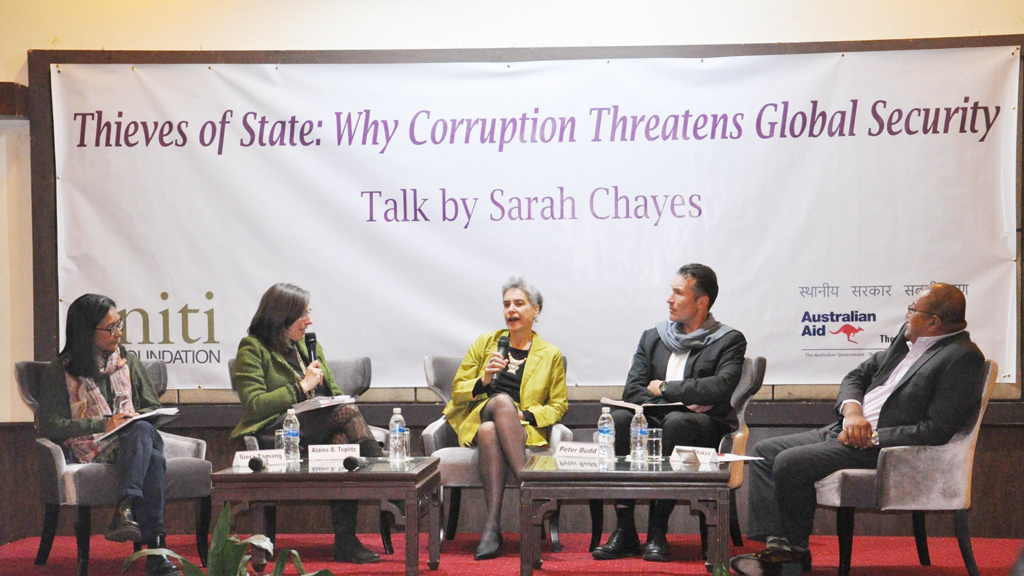
“In January 2018, award-winning author Sarah Chayes partnered with Niti Foundation and the Asia Foundation to conduct a series of events and conversations seeking to shed light on the systems of corruption and impunity in Nepal. The events engaged stakeholders strategically, each meeting having a unique purpose and degree of publicity to productively shape discourses and public policy considerations. Alongside seeking to re-imagine the discursive landscape in this important political moment for Nepal, the purpose of Chayes’ visit equip actors with the tools to consider how networks of corruption operate and what can be done to dismantle them.
The discussions that transpired revealed that recent decades have seen corruption transform in Nepal from individual and opportunistic acts to shifting alliances of vertically and horizontally integrated sub-networks between public, private and criminal sectors.
The period political instability and transition has been critical in leading to these horizontal links forming between the political parties, the business sector and apex advisory and regulatory bodies. These partnerships have ensured that a culture of impunity has flourished. Through either hollowing out or weaponizing regulatory bodies and judicial authorities, Nepal’s kleptocratic network has rendered its members unimpeachable – enabling them to continue in illegal rent-seeking activities. The international dimension of this horizontal structure is particularly important in the context of Nepal, where both international money channels and bodies have been intimately involved in the enabling of systems of collusion to grow.
Nepal’s history of unitary, top-heavy state governance has provided the fertile soil for the vertical integration of Nepal’s kleptocratic network. The lack of formal political channels at the local and provincial levels have enabled corruption, in the words of a pre-eminent journalist at the Chayes events, “to enter through the local capillaries” and for impunity prevail from the “village contractor level to the national contractor level”. This impunity has been able to flourish as a consequence of the kleptocratic network’s ownership of the Nepal’s justice sector.”
Leave A Comment
You must be logged in to post a comment.