
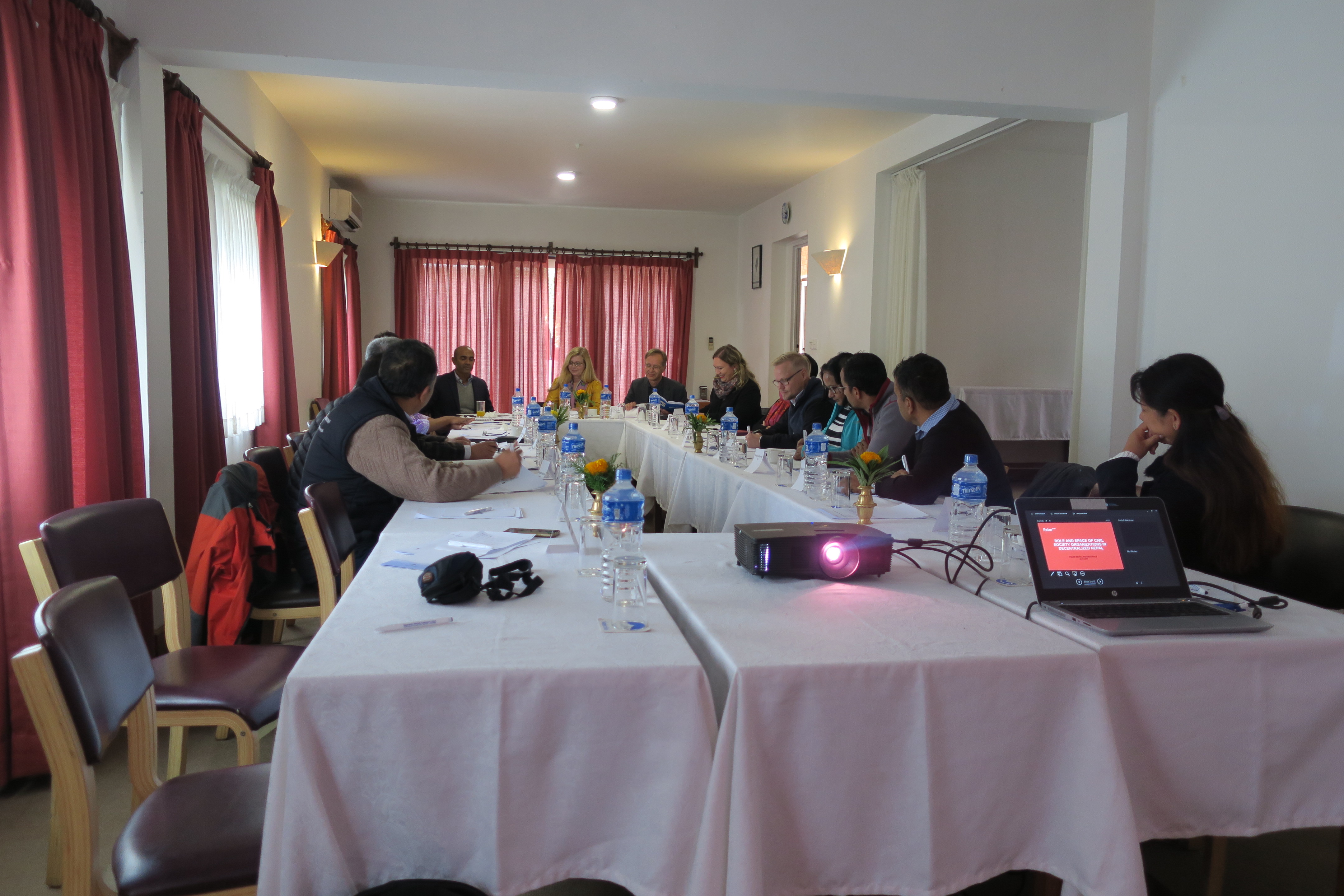
Dr. Varughese began with a situation update in Nepal and how the transition from 1 government to 761 governments came about. Under the new Constitution promulgated in September 2015, each of these 761 governments are co-equal. He also briefly described the modern political history of Nepal and explored the idea of civil society as political community during that period. Essentially, Nepal has seen from 1959 till the 1990s, a group of political parties acting as civil society in confronting absolute monarchy. However, post the popular movement and the end of absolute monarchy in 1990-91, there has been minimal civic engagement from political parties and civil society as political community diminished in role and relevance. Instead, what Nepal witnessed is a burgeoning of non-state developmental actors such as NGOs that essentially worked as development contractors or agents for donors who increasingly focused their assistance to Nepal in the areas of human rights, good governance, and democratic development.
Civil society as an amalgamation of civil coordination and social organization, has rarely been visible in Nepal. Most non-state actors were coopted into the service of government or donors in the name of development, with very little emphasis on developing the public realm through civic engagement. Dr. Varughese shared that with the shift to federalism, spaces have not shrunk; rather they have multiplied and shifted. That is to say, within a federal system, there is now more space to engage in civil coordination and social organization with 761 units of governments instead of 1. Identifying these spaces, however, is the task at hand for those who seek to support civil society. While critical engagement with the state is necessary even more support is required for civil society to build democratic leadership, deliberation and participation in the public realm.
Dr. Varughese was invited as the chief speaker at a roundtable organized by Finnish Evangelical Lutheran Mission (FELM) in Nepal on 22nd November 2018 at Summit Hotel, Kathmandu. The session was opened by Teressa Teressa Juhaninmäki, Regional Manager for Development Cooperation, Felm-Nepal followed by a discussion and closing remarks provided by Christine Stukaloff, Deputy Director of International Cooperation, Felm.
Leave A Comment
You must be logged in to post a comment.